Family preparedness
Lighting, homework and dinner: budgeting a family evening
Household backup earns its place through small things: light over the table, a connection, warm food and time to finish work. Planning that evening does not require a promise to power everything at once.
Updated:
Quick answer
Plan the evening in blocks: homework and work, brief kitchen tasks, leisure and overnight reserve. Agree a shared limit for optional devices. This reduces accidental peaks and preserves energy until the next recharge.
Fictional household scenario · not a customer account
When this becomes a household question
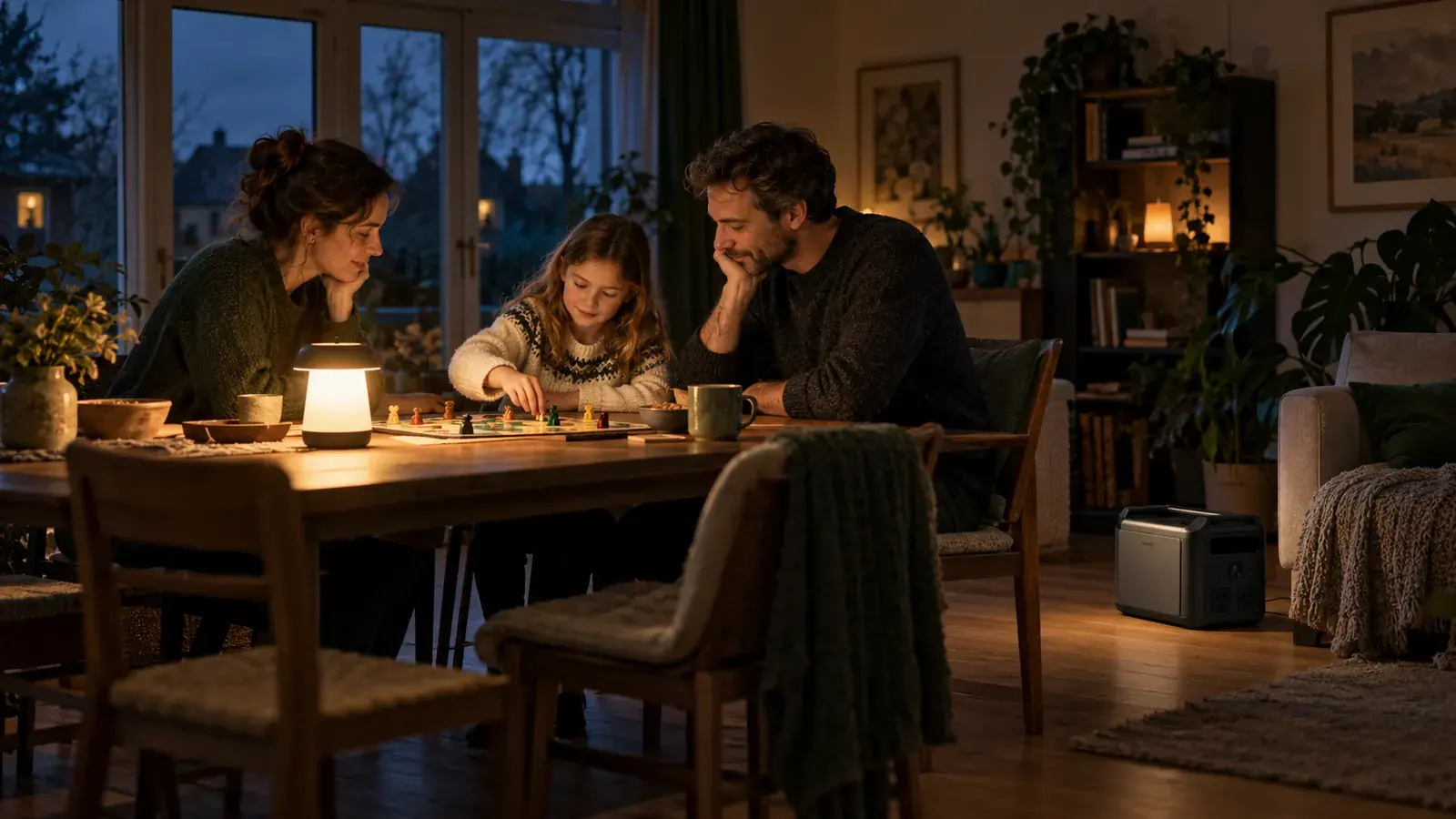
Imagine a family with a school-age child. One adult finishes work, another prepares dinner and the child needs light for studying. Not every appliance is needed by everyone or throughout the evening. Coordination matters as much as a large number in a catalogue.
Agree what stays on
Identify continuous tasks such as communications and essential lighting, then schedule the rest. A short understandable list avoids holding a household meeting beside the station each time. It also helps prevent accidental use of a large load. Include the minimum charge the family wants to preserve.
Small loads add up
One lamp looks negligible; several lamps over an evening deserve their own line. The same applies to chargers, a monitor and networking equipment. A detailed list gives you control rather than merely letting you watch the battery percentage fall. The example makes its assumptions explicit.
A worked example with explicit assumptions
This is an illustrative scenario, not a measurement of your appliances: 1,024 Wh capacity, 10% reserve, assumed 85% efficiency and 8 W idle draw. A 124.5 W average load gives approximately 5.97 hours. For a 4-hour target, the calculated nominal capacity is about 686.54 Wh. Startup demand and output limits require a separate check; this calculation does not establish compatibility.
| Device | Running W | Quantity | Duty cycle |
|---|---|---|---|
| Lighting in three areas | 8 | 3 | 100% |
| Homework laptop | 45 | 1 | 100% |
| Internet equipment | 18 | 1 | 100% |
| Television, half the interval | 75 | 1 | 50% |
Make the rules easy for everyone
One person may lead setup, but all adults should understand the basics: where the torch is, which cables to leave alone and which optional loads to stop when charge runs low. Plan ventilation, children’s access and placement in advance. A workable routine should not require constantly moving a heavy unit.
Before you decide
- Agree optional devices and operating times.
- Ring-fence overnight energy.
- Leave connections to a responsible adult.
Common questions
Does switching off an extra screen help?
Yes, if it draws power. Enter the measured watt reduction to estimate the benefit.
Should a nightlight be removed to save energy?
Do not compromise safe movement around the home. Reduce less important loads first.
Verification and selection references
Original specification evidence is retained in the editorial research archive. Links below lead to Ukrainian shop pages. Calculations do not guarantee compatibility, runtime or stock.

