Home appliances
A family kitchen energy budget during an outage
A hot dinner might mean a few minutes of appliance use or a long electric cooking session. Those are very different demands on a household reserve.
Updated:
Quick answer
Budget each kitchen task in watt-hours: multiply power by the fraction of an hour used. Kettles, toasters and cookers may run briefly but have high simultaneous demand. Schedule tasks sequentially without consuming the reserve intended for refrigeration and communication.
REVIEWS ON OTHER PLATFORMS
What buyers share — with links to their photos
These are brief summaries of public reviews. The platform purchase label and attached photos were checked; author identities and reported results were not independently verified. These are not our interviews or tests.
Reports water heating and a noticeable charge drop under a substantial load.
No complete measurement protocol; capacity estimates in the review are not treated as specifications.
Describes kitchen loads, rapid battery use and an odour during charging.
An odour report does not establish safe operation. Its cause and the unit’s condition were not independently checked.
Photos open on the source site. Permission to republish has not been established, so the files are neither copied nor embedded. ROZETKA links may open a shared review feed: look for the stated author and date; several seller listings can show the same reviews.
Fictional household scenario · not a customer account
When this becomes a household question
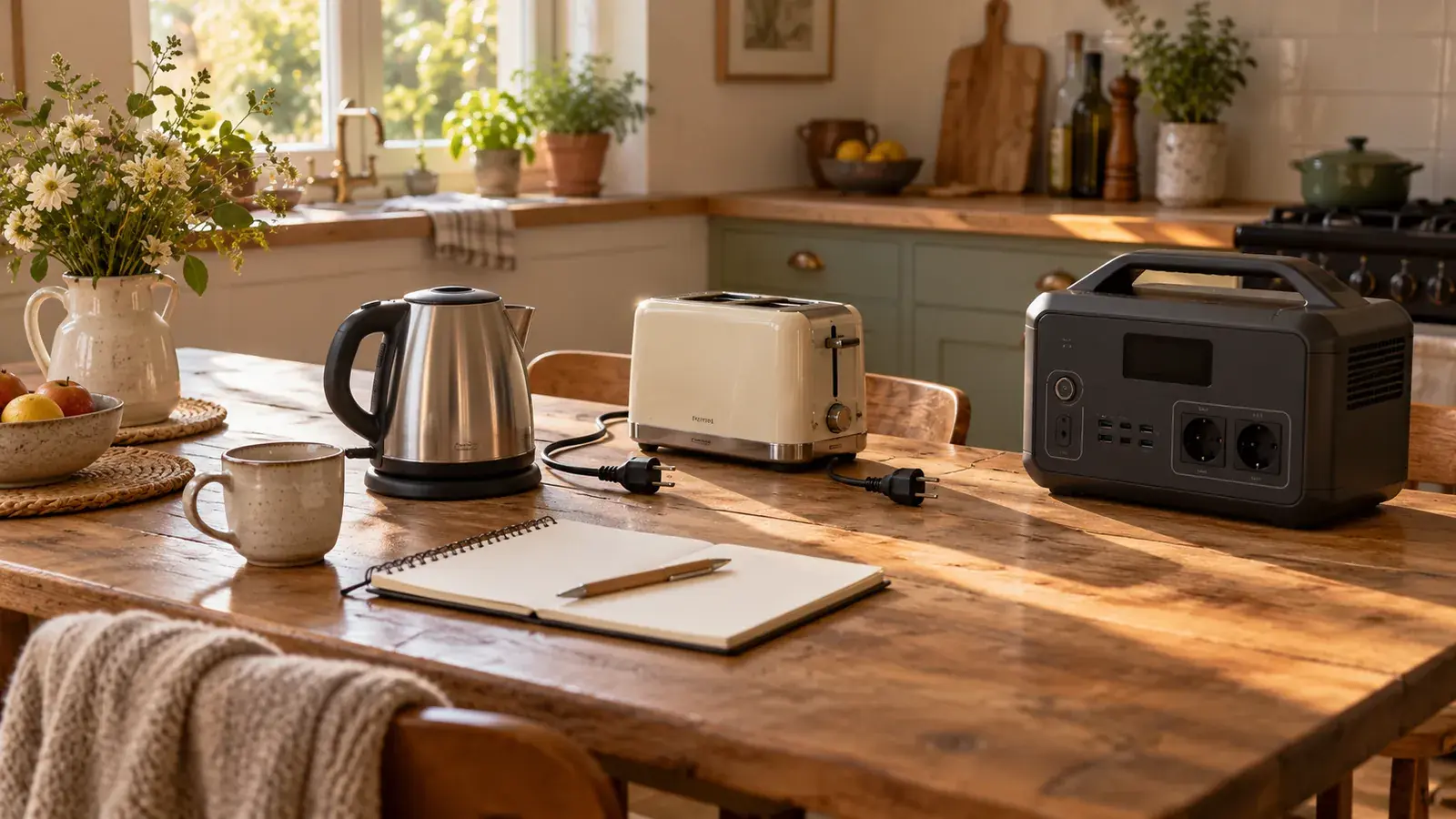
Consider an evening when dinner is already cooked and only needs reheating. A microwave, kettle and electric hob are nearby. Plugging everything in is convenient, but the habit of using them together can create unnecessary peak demand. A task-based plan is more useful than a list of kitchen sockets.
Start with what needs to reach the table
Separate reheating food, boiling water for a drink and prolonged cooking. High watts do not automatically mean the most watt-hours; duration matters. The station must still support the appliance’s input demand. A brief task can fit the energy budget yet exceed inverter output.
Read input demand, not just the front label
A microwave’s advertised cooking output is not necessarily its electrical input. Check documentation and operating mode. Use the relevant input figure for each appliance, rather than the most prominent number. All loads in the worked example are assumptions used to explain the method.
A worked example with explicit assumptions
This is an illustrative scenario, not a measurement of your appliances: 2,048 Wh capacity, 10% reserve, assumed 85% efficiency and 10 W idle draw. A 220 W average load gives approximately 6.86 hours. For a 2-hour target, the calculated nominal capacity is about 597.39 Wh. Startup demand and output limits require a separate check; this calculation does not establish compatibility.
| Device | Running W | Quantity | Duty cycle |
|---|---|---|---|
| Kettle, 6 minutes in 2 hours | 1,800 | 1 | 5% |
| Microwave, 10 minutes in 2 hours | 1,200 | 1 | 8.33% |
| Lighting and internet | 30 | 1 | 100% |
Dinner should leave something for the night
Before cooking, check what must stay on until the next recharge. Running appliances in sequence can reduce simultaneous power, but it does not erase the energy they use. Budget dinner alongside refrigeration, communications and lighting rather than treating it as a free extra.
Before you decide
- Convert minutes to fractions of an hour.
- Check electrical input power.
- Agree a sequence for high-power appliances.
Common questions
Does a low average load permit any kettle?
No. The inverter must support the kettle’s full running power while it is on.
Does this example recommend particular kitchen appliances?
No. Durations and wattages are assumptions to replace with your measurements.
Verification and selection references
Original specification evidence is retained in the editorial research archive. Links below lead to Ukrainian shop pages. Calculations do not guarantee compatibility, runtime or stock.

