Apartment backup
Where to place a power station: noise, bedrooms and ventilation
In a catalogue, it is easy to picture a station as a quiet box. At home there are fans, cables and the question of whether you can comfortably sleep or work nearby.
Updated:
Quick answer
Choose placement based on cooling clearance, dryness, stability and cable access. Fan noise may vary with charging and load. Never cover or enclose the station simply to make it quieter.
REVIEWS ON OTHER PLATFORMS
What buyers share — with links to their photos
These are brief summaries of public reviews. The platform purchase label and attached photos were checked; author identities and reported results were not independently verified. These are not our interviews or tests.
Discusses refrigeration, fan behaviour and difficulties connecting the app.
Conditions concern one setup; the reported duration was not independently tested.
Photos open on the source site. Permission to republish has not been established, so the files are neither copied nor embedded. ROZETKA links may open a shared review feed: look for the stated author and date; several seller listings can show the same reviews.
Fictional household scenario · not a customer account
When this becomes a household question
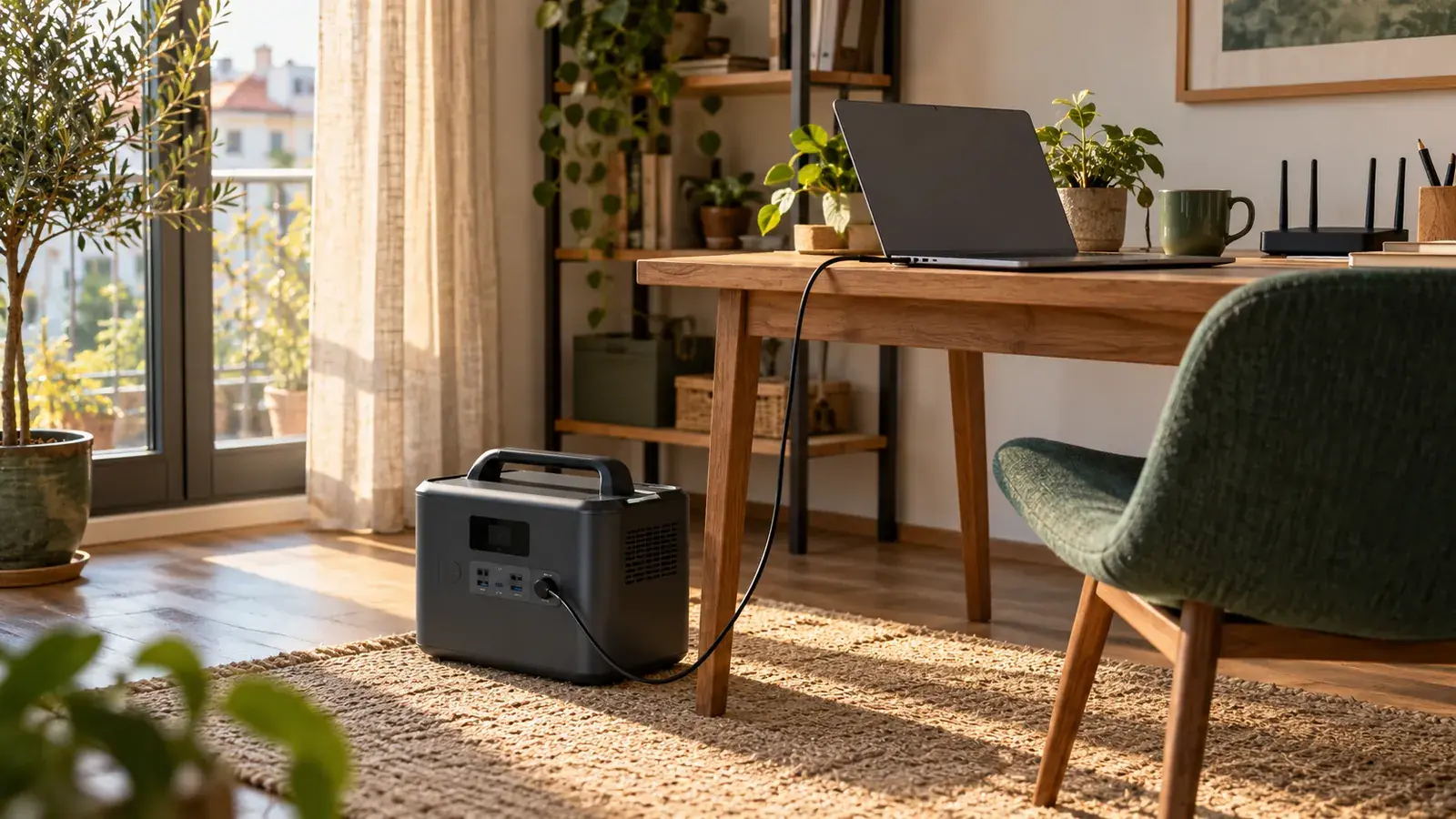
Imagine a small flat where the bedroom doubles as a home office. There is a socket beside the desk, exactly where quiet matters. Hiding the station under fabric or behind furniture seems convenient until cooling enters the picture.
Noise depends on what the station is doing
Charging, load and temperature can change fan behaviour. One operating mode does not describe all the others. We have not measured these devices’ noise, so we do not call them silent or suitable for every bedroom. Ask for available data and the conditions behind it before buying.
Do not trade ventilation for quiet
Follow the manual’s clearances and conditions. Do not cover the unit or use a tight closed cupboard as soundproofing. Choose a dry stable place with suitable cable routes. A few minutes without an error or smell do not establish that improvised placement is safe.
A worked example with explicit assumptions
This is an illustrative scenario, not a measurement of your appliances: 1,024 Wh capacity, 10% reserve, assumed 85% efficiency and 8 W idle draw. A 28 W average load gives approximately 22.51 hours. For a 8-hour target, the calculated nominal capacity is about 363.92 Wh. Startup demand and output limits require a separate check; this calculation does not establish compatibility.
| Device | Running W | Quantity | Duty cycle |
|---|---|---|---|
| Night lighting | 5 | 2 | 100% |
| Internet equipment | 18 | 1 | 100% |
Check how the room is actually used
Walk through the routes from the door to the bed and desk. Cables should not become obstacles, and a heavy unit should not need moving around at night. Plan charging according to the manual. If comfortable use seems to require covering the unit or blocking airflow, choose another location.
Before you decide
- Check conditions behind noise claims.
- Keep ventilation clearance and shutdown access.
- Keep cables out of nighttime walkways.
Common questions
Is a cupboard with open doors acceptable?
Do not assume cooling is adequate. Placement must meet the full requirements of the exact manual.
Does higher capacity necessarily mean more noise?
No. Assess cooling design and the actual operating mode.
Verification and selection references
Original specification evidence is retained in the editorial research archive. Links below lead to Ukrainian shop pages. Calculations do not guarantee compatibility, runtime or stock.

