Apartment backup
Choosing an apartment power station: start with an evening without power
When the power goes out, a model name is not much help. What matters is finishing work, keeping the internet on and finding room for a heavy battery. That is where a sensible choice begins.
Updated:
Quick answer
Start with essential appliances and backup hours. Output must handle simultaneous and startup demand, while capacity must cover energy use over the outage with a reserve. The number of rooms alone does not determine the right station.
REVIEWS ON OTHER PLATFORMS
What buyers share — with links to their photos
These are brief summaries of public reviews. The platform purchase label and attached photos were checked; author identities and reported results were not independently verified. These are not our interviews or tests.
Notes compactness without a detailed load list or measurements.
A general user impression cannot replace your watt-hour budget.
Shares positive first impressions while explicitly noting limited experience.
An initial impression rather than a long-term runtime or reliability assessment.
Photos open on the source site. Permission to republish has not been established, so the files are neither copied nor embedded. ROZETKA links may open a shared review feed: look for the stated author and date; several seller listings can show the same reviews.
Fictional household scenario · not a customer account
When this becomes a household question
Imagine a family in a two-bedroom flat. One adult needs to finish work, a child needs a desk lamp and everyone needs a connection. It is tempting to add the kettle, water heater and space heater to the list. Treat every appliance as equally essential, though, and the purchase soon grows heavier and more expensive than the evening requires.
What actually needs to stay on
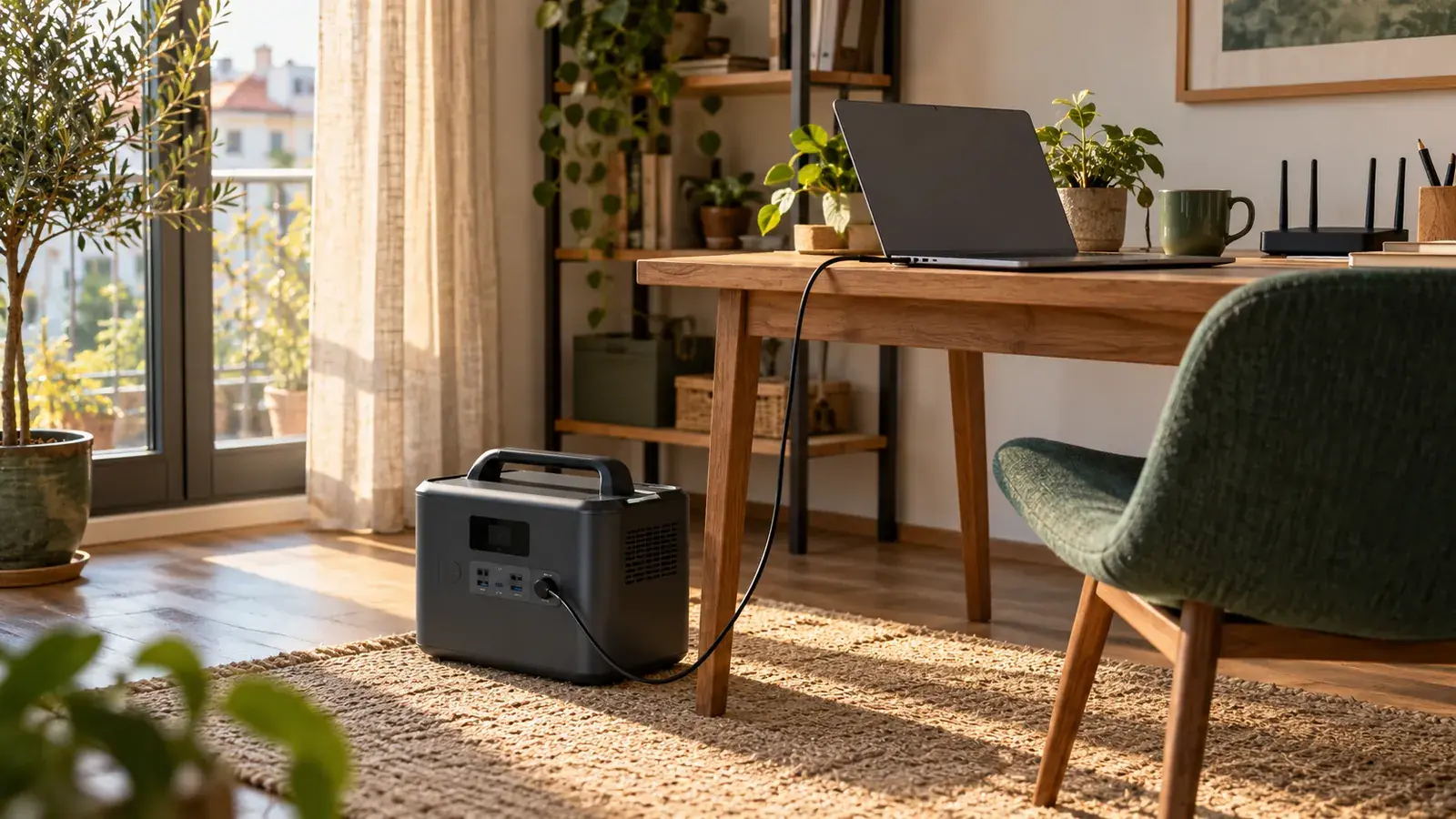
List the equipment that makes the next outage manageable, rather than everything you own. A router and optical terminal, a laptop and two lamps form a useful starting point. Add the fridge separately because its compressor cycles and needs to start. Give the kettle a brief task, not six continuous hours. That list tells you more than a recommendation based on the number of rooms.
The kettle works. What is left in the battery?
A station has two different limits. Watts describe the load it can supply; watt-hours describe stored energy. Running a powerful appliance does not establish how long the rest of your evening will last. When comparing F1800 and F2400, look at both figures and check appliance startup requirements. A fridge’s average consumption alone does not establish compatibility.
A worked example with explicit assumptions
This is an illustrative scenario, not a measurement of your appliances: 1,024 Wh capacity, 10% reserve, assumed 85% efficiency and 8 W idle draw. A 89 W average load gives approximately 8.18 hours. For a 6-hour target, the calculated nominal capacity is about 751.37 Wh. Startup demand and output limits require a separate check; this calculation does not establish compatibility.
| Device | Running W | Quantity | Duty cycle |
|---|---|---|---|
| Router and ONT | 18 | 1 | 100% |
| Laptop | 55 | 1 | 100% |
| Two LED lights | 8 | 2 | 100% |
Find its place before you buy
Picture carrying the station from the entrance to its charging spot. Are there stairs? Will there be room for ventilation? Will cables cross a doorway? Add fan noise and recharge time to the decision. A useful home purchase should fit the routine rather than make you reorganize it during every outage.
Fictional conversation · not a customer interview
Talking through the choice
This fictional conversation explains practical questions. The speakers are invented; it is not an interview or a customer account.
- We want to keep the whole flat running. Where do we start?
- Start with one actual evening. Name the devices and hours you cannot do without, then work out what else the reserve can support.
- So the biggest station is not always the easiest choice?
- Correct. It still needs a suitable place, manageable weight and enough time to recharge. A larger battery does not remove those practical questions.
Before you decide
- Measure essential device consumption.
- Check refrigerator startup and the operating mode.
- Check weight, ventilation and recharge time.
Common questions
Does an apartment need 3000 W?
Only if simultaneous loads require it. For internet and a laptop, a high output rating does not replace energy capacity.
Can I feed the apartment through a wall socket?
No. Use station outputs for individual devices; an electrician must design isolated backup circuits.
Verification and selection references
Original specification evidence is retained in the editorial research archive. Links below lead to Ukrainian shop pages. Calculations do not guarantee compatibility, runtime or stock.

